
Buying Hashrate as a Service: 255 TH/s to 2.55 PH/s
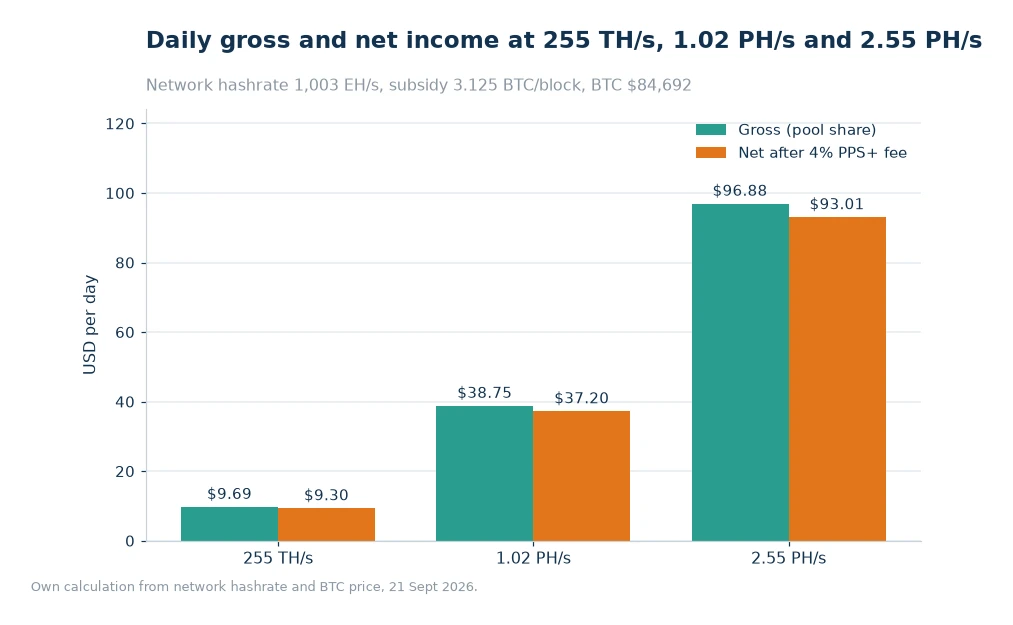
A miner who does not want to own a building can still own the output. One 255 TH/s unit credits 0.00011439 BTC a day, which is $9.69 gross at $84,692 and $9.30 after the listed 4% on the block-reward component. Ten of them credit 0.00114395 BTC, or $96.88 gross. The question is what the supplier charges to stand between the machine and the pool.
Key takeaways
- 255 TH/s credits 0.00011439 BTC a day, or $9.69 gross and $9.30 net of the listed 4%.
- 1.02 PH/s is four units of that size and credits 0.00045755 BTC a day.
- 2.55 PH/s is ten units and credits 0.00114395 BTC a day, $96.88 gross.
- A service contract adds a fee per machine or per kilowatt-hour, which the pool never sees.
What a service arrangement actually splits
Mining as a service separates ownership from operation. Someone owns the hardware and carries its depreciation. Someone supplies the building, the power and the technicians. Someone holds the pool account and receives the coins. Those three roles can sit with one company, two companies or the same person in different hats, and the contract should say which is which before any money moves.
The split matters because each role carries a different risk. The owner of the hardware carries the risk that a newer model arrives. The operator carries the risk of a power price rise and a repair bill. The account holder carries the risk of a payout address mistake. A well-written agreement names all three, and a vague one usually leaves the repair bill unnamed until it appears.
Three sizes on one contract
The table multiplies a single 255 TH/s unit, which keeps the comparison clean. Efficiency and price are held constant, so the only variable is how many units sit under the contract.
| Contracted hashrate | Units at 255 TH/s | BTC per day | Gross USD | Net USD |
|---|---|---|---|---|
| 255 TH/s | 1 | 0.00011439 | $9.69 | $9.30 |
| 1.02 PH/s | 4 | 0.00045755 | $38.75 | $37.20 |
| 2.55 PH/s | 10 | 0.00114395 | $96.88 | $93.01 |
The unit column is the one to negotiate against. A provider quoting a flat fee for "a rig" may be quoting for a different machine than the one in your calculation, and hashrate per unit is the only honest way to compare two offers. Ask for the model, the efficiency and the hashrate at the wall rather than at the chip.
Worked example
Start with one unit and scale to the contract size you are considering.
- Network output: 3.125 BTC × 144 blocks = 450 BTC a day.
- BTC per TH/s: 450 ÷ 1,003,107,267 = 0.00000044861.
- 255 TH/s: 255 × 0.00000044861 = 0.00011439 BTC.
- Gross value: 0.00011439 × 84,692 = $9.69.
- Listed 4% on the block-reward component: 9.69 × 0.04 = $0.39, leaving $9.30.
- Four units: 4 × 0.00011439 = 0.00045755 BTC, or $38.75 gross and $37.20 net.
- Ten units: 10 × 0.00011439 = 0.00114395 BTC, or $96.88 gross and $93.01 net.
- Thirty days at ten units: 96.88 × 30 = $2,906.40 gross before any service fee.
The questions a provider list cannot answer
Directories tell you who exists. They cannot tell you how a specific contract treats a failed board, whether the fee pauses during a power cut, or what notice you owe before leaving. Those three terms decide more of the outcome than the headline rate, and they are the ones a sales page tends to leave for the call.
Ask for them in writing, in the same order, from every provider you shortlist. Then put the answers beside the daily credit at your contracted hashrate. At 2.55 PH/s the credit is $93.01 net, so a fee of $20 a day is 21% of it while a fee of $5 is 5%. The percentage is what matters, and it is easy to compute once both numbers are on one line.
Where the directories help
The ViaBTC Mining Companies directory lists businesses in the sector, and it is a reasonable first pass when the goal is to see how many kinds of provider exist rather than to pick one. The Miner Hosting section beside it covers the arrangements where a provider runs machines owned by someone else, which is usually the category a newcomer wants.
For the facilities themselves, the Mining Farms listing shows hosting options and is the closest thing to a menu of what a slot includes. Neither page substitutes for a contract review, but together they turn an opaque market into a set of named categories that can be compared.
Contract length against hardware life
A service agreement usually runs longer than a single difficulty cycle and shorter than the useful life of the hardware. That mismatch is where most of the risk sits. Signing a two-year term on a machine whose efficiency will be ordinary in twelve months transfers the ageing risk to the customer while the provider keeps a fixed fee.
The defence is not to avoid long contracts but to price the exit. Ask what it costs to leave early, whether the hardware can be moved, and whether the fee steps down as the machine ages. An agreement with a clear exit is worth a slightly higher rate, because it keeps the option to stop paying for a machine that no longer earns its keep.
Depreciation is the part of the calculation most service quotes leave out. A unit that earns $9.30 a day today will earn less after two difficulty rises, while the fee is likely to stay where it is. Model that in advance: take the credit at 80% of today's difficulty-adjusted value and check whether the fee still leaves a margin. If it does not, the contract is a bet that difficulty will stand still.
Financing the hardware without selling the coins
An operation that wants to keep its coins while paying for power can borrow against them instead of selling. The Collateral-Pledged Loans product follows a fixed sequence: Add Collateral, then Apply for Loan, then Receive Loan, then Repay Loan, and finally Redeem Collateral. Each step is a separate action, which makes the schedule easy to audit against a repayment plan.
Borrowing against collateral is a leveraged position whatever the label says, so the size of the loan should be set against the credit at your contracted hashrate rather than against the price you hope for. At 255 TH/s a day is $9.30 net; at 2.55 PH/s it is $93.01, and a repayment schedule that assumes the second figure on the first hashrate will not survive a slow month.
Frequently asked questions
How much does 255 TH/s earn in a day?
0.00011439 BTC at the 21 Sept 2026 inputs, which is $9.69 gross at $84,692 and $9.30 after the listed 4% on the block-reward component.
What separates Mining Companies from Miner Hosting?
The first covers companies in the mining business, while the second lists providers that host machines owned by someone else; both describe the supply side rather than the pool's own payouts.
Can a hosted operation borrow against its collateral?
Yes, through Collateral-Pledged Loans, which runs Add Collateral, Apply for Loan, Receive Loan, Repay Loan and Redeem Collateral in that order.
Put the fee beside the credit
Whatever the arrangement is called, the test is the same: daily credit at the contracted hashrate on one line, all-in daily fee on the next, and the difference expressed as a percentage of the first. At 255 TH/s the credit is $9.30 net, which sets the scale for a single-unit contract. At 2.55 PH/s it is $93.01, and a fee that looked reasonable on one unit can be a different proposition at ten.
Run the comparison before signing and again after the first full month. The second pass uses a measured hashrate instead of a quoted one, and it is the version worth keeping.
Sources: the ViaBTC companies, farms and loan pages for directory categories and product steps[1]. Inputs read 21 Sept 2026: 1,003 EH/s, 132.76 T, 3.125 BTC per block, 144 blocks a day, BTC $84,692. Published 22 Oct 2026; credit figures assume constant difficulty and full uptime.