
NDA and Mould Ownership in OEM Jewelry Manufacturing
Two promises decide whether a custom jewelry order is safe to place: the design stays yours, and the mould is cut once for your brand only. Both sit under a 100% NDA that covers the whole engagement, from the first consultation to the last carton. On the OEM/ODM schedule nothing unusual follows — CAD back within 3–4 weeks in production after a 25–30 day sample and 48 hours of CAD for the run.

Key takeaways
- Moulds, CAD files and the developed collection stay exclusive to your brand and are not resold or published.
- 100% NDA coverage applies from the consultation stage, before a drawing exists.
- Designs are exclusive to your brand rather than added to a house range under either OEM or ODM terms.
- Sampling runs 25–30 days and production 3–4 weeks, unchanged by the confidentiality terms.
What an NDA covers on a jewelry order
Four things need to be inside it: the sketches and reference material you send, the CAD files derived from them, the moulds cut for your designs, and the collection itself as a design rather than as a product. A confident confidentiality clause names all four instead of referring vaguely to "the design".
The timing matters as much as the wording. If the NDA only kicks in once a purchase order exists, the drawings sent before that point are unprotected — and the drawings are the asset most easily copied.
Moulds: cut once, for one brand
A mould is the physical form of your design. It is also the object most likely to be reused if nobody asked about it, because reusing a mould costs a factory nothing while cutting a new one costs a tooling fee. The published position is straightforward: moulds, CAD files and the collection are not resold and are not shown to other buyers.
Ask the question in tooling terms rather than legal terms. Who holds the mould, where is it stored, and what happens to it if you stop ordering? A supplier with a document routine answers all three without checking.
Why the CAD stage is the leak risk, not the bench
The bench is noisy and visible; a file is neither. Inside a 48-hour CAD turnaround, your design exists as a digital asset that can be opened, copied and mailed, which is why access control belongs in the agreement and not only in the IT policy.
This is also the stage where the design is most useful to someone else, because a drawing can be re-cut anywhere while a finished piece can only be copied by hand. A brand working with ODM jewelry production services should ask two questions at kick-off: who can open the file internally, and what is stored after the order ships.
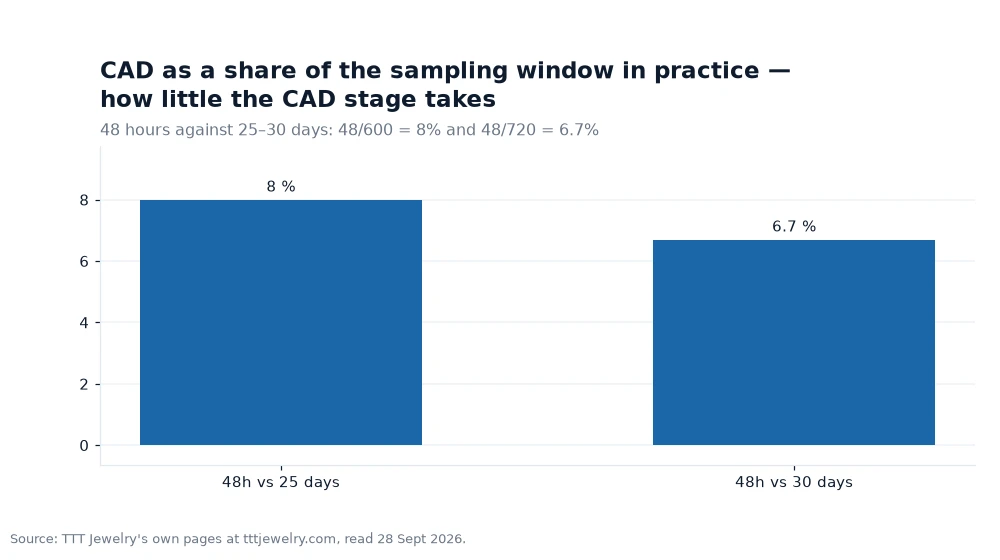
Worked example: 48 hours as a share of 25 and 30 days
The CAD stage is published at under 48 hours, so it is the shortest exposure window in the project — but its share of the whole depends on which end of the sampling range you use. Against 25 days, converted to hours as 25 × 24 = 600, the share is 48 ÷ 600 = 0.08, or 8%. Against 30 days, or 720 hours, it is 48 ÷ 720 = 0.067, about 6.7%.
So the drawing exists for roughly 7–8% of the time the sample is being built — short, but the only part of the project that leaves the building as a file. The divisions are my arithmetic; 48 hours and 25–30 days are the published windows.
Packaging and logo tooling under the same terms
Confidentiality extends past the metal. A brand name on a foil-stamped box, on a metallic logo tag, on a backing card or in a barcode label tells anyone who walks past the packing bench whose order is going out. If the collection is meant to be unreleased, packaging is part of the secret rather than an afterthought.
The practical fix is to sequence the work: metal and stones first, branded packaging last, so the packing bench only sees your logo when the collection is about to ship anyway.
| Asset | Published position | Question to ask |
|---|---|---|
| Moulds | Not resold, not shared | Where are they stored and for how long |
| CAD files | Not published as house designs | Who can open the file internally |
| Collection design | 100% exclusive to your brand | Is it offered to other buyers, ever |
| Engagement overall | 100% NDA | When does cover start |
What to ask for in writing, in order
Start with the exclusivity sentence, because it is the one everything else depends on. Then the mould ownership line, then the file-access answer, then the packaging sequence. Four lines of text, sent before the first CAD drawing, remove most of the risk that a design walks out of a workshop.
Buyers who leave those questions until the second order usually discover the arrangement was never written down, which is a bad time to find out.
When a brand outgrows its supplier
Exclusivity also has to survive a change of factory. If the design and the CAD files are yours, a move means new tooling rather than a fresh development cycle, and the approved drawing is the document the next supplier quotes from. Without it, a move restarts the 48-hour drawing stage and the 25–30 day sample as if nothing existed.
Archive the drawing at approval, not at delivery. It is the only version of the design that both sides agreed to.
What a design archive looks like after year one
By the end of a first year a label has three things worth keeping together: the approved drawing per design, the production sample it was signed against, and the batch inspection records for each run. Filed that way, a reorder is a matter of naming a version rather than rebuilding a brief.
Workshops ask for the same material when a second run is quoted, which is why the archive belongs to the buyer rather than to the supplier. It is the difference between owning a design and renting one season of it.
Frequently asked questions
Does the NDA cover sketches I send before placing an order?
It should. The published coverage is 100% NDA from the engagement, which includes the consultation stage that happens before any drawing or sample exists.
Can the factory use my mould for another customer?
No. Moulds are cut for your account and are not resold or shared, so a second buyer wanting the same design needs their own tooling.
Who owns the design if the factory drew it under ODM terms?
You do. ODM development produces a collection that stays exclusive to your brand rather than a design the factory can reuse in its own catalogue.
Making the safe choice the easy one
Confidentiality is not a legal formality in this trade, it is the difference between a design that launches once and a design that appears on three marketplaces in the same month. The good news is that the questions are short and the answers are checkable: who holds the mould, who can open the file, and what is in circulation.
Ask them once, in writing, and keep the replies. Brands building a first collection for their own label should also plan the packaging side early, which the private-label programs set out line by line, and it is worth knowing what the factory floor actually contains before promising a retail date.
The list this piece builds on — the approved-sample benchmark / the 100% NDA terms, followed by the laser engraving stage — is listed at the brand's own pages at the tttjewelry.com address, as of 28 Sept 2026. Quality management is covered by ISO 9001:2015 on those pages. The restatement in weeks is mine alone — the site supplies the inputs only [1]